


Have you ever felt like every few months, all the tech giants are talking about how a new piece of technology is going to save the world, and then… you never hear about it again?
If you have, you are certainly not imagining it. It’s called the Gartner Hype Cycle.
At its core, the Hype Cycle is a way of describing how new technologies tend to be adopted over time — emotionally, organizationally, and practically. Almost every emerging technology follows the same rough path:
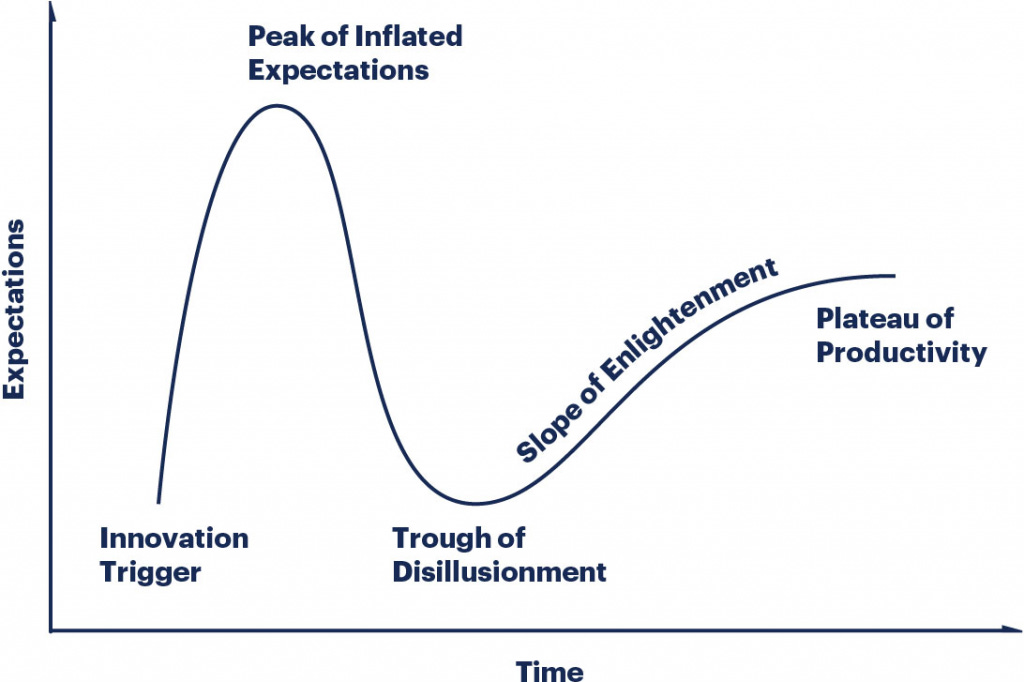
Innovation Trigger
A breakthrough or idea appears. Early demos look promising. Few people are using it, but excitement builds.Peak of Inflated Expectations
Headlines explode. Vendors overpromise. Leaders expect instant transformation. Reality hasn’t caught up yet.Trough of Disillusionment
The cracks show. Projects stall. Tools don’t magically fix broken processes. Many people give up here.Slope of Enlightenment
The technology doesn’t disappear — it gets quieter. Practical use cases emerge. Expectations normalize.Plateau of Productivity
The technology becomes boring — and that’s a good thing. It’s stable, useful, and integrated into real work.
We care about the Hype Cycle because most tech failures aren’t technical failures. They are instances of inflated expectation. When organizations adopt tools at the peak without the systems, support, or clarity to sustain them, chaos follows.
With that lens, let’s look at three very current technologies — and where they realistically sit on the curve.
1. AI-Native Development Platforms
(Hovering near the Peak of Inflated Expectations)
AI-native development platforms are tools built to work with AI at every stage of software creation, using human intent and oversight to guide AI-generated code and workflows.

AI-native development platforms promise something incredibly appealing:
“Build software faster, with fewer people, using AI as a built-in collaborator.”
Instead of writing every line of code manually, developers can describe what they want, refine outputs, and let AI handle repetitive or boilerplate work. In theory, this lowers costs, speeds up development, and makes software creation more accessible.
The promise is real, but the hype is high.
What’s often missing from the conversation is that software is more than code. It’s decisions, tradeoffs, maintenance, documentation, and long-term responsibility. AI can accelerate parts of the process, but it doesn’t replace:
Clear requirements
Thoughtful architecture
Ongoing ownership
Governance and security
Many teams adopt these platforms expecting immediate efficiency gains, only to discover they’ve created systems that are harder to understand, harder to debug, and harder to maintain.
Why this matters:
AI-native platforms are powerful when paired with strong systems thinking. Without that foundation, they amplify confusion instead of reducing it.
The organizations that will benefit most are the ones using AI to support human judgment.
2. Multi-Agent AI Systems
(Sliding toward the Trough of Disillusionment)
Multi-agent AI systems are setups where instead of one AI doing everything, different agents may plan work, carry out actions, check results, or refine outputs. These systems are designed to handle more complex workflow. When used thoughtfully, multi-agent systems can improve efficiency in narrow, well-defined use cases — but they still require human guidance and clear structure to remain reliable.

Multi-agent systems are exactly what they sound like: instead of one AI doing one task, you have multiple AI “agents” working together, each responsible for a role — planning, executing, checking, refining.
On paper, it looks like digital teamwork.
However, when practiced it can become complicated.
Coordinating multiple agents introduces new challenges:
Who’s responsible when something goes wrong?
How do you validate decisions made by autonomous systems?
How much oversight is required to keep things reliable?
A lot of organizations jumped into agent-based systems hoping they’d replace large chunks of human labor. Many are now realizing that managing AI agents still requires people, structure, and ongoing care.
This doesn’t mean agentic AI is a dead end. We’re leaving the fantasy stage and entering the reality stage.
Why this matters:
Multi-agent systems work best in narrow, well-defined environments — not as general replacements for teams or workflows. The hype suggested autonomy. The reality demands stewardship.
3. Preemptive Cybersecurity & AI-Driven Defense
(Climbing the Slope of Enlightenment)

Cybersecurity has traditionally been reactive:
Something breaks
Something gets breached
Everyone scrambles
Preemptive cybersecurity flips that model.
Using AI, behavioral analysis, and pattern recognition, these systems aim to identify risks before damage occurs — unusual logins, abnormal access patterns, or system behavior that doesn’t match the norm.
Unlike many AI trends, this one is becoming quietly practical.
Organizations are using these tools to:
Reduce response time
Catch issues earlier
Lower the emotional and operational cost of emergencies
There’s still complexity here — AI can produce false positives, and attackers adapt — but expectations are becoming more realistic.
Why this matters:
This technology succeeds because it aligns with how people actually work. It supports human decision-making instead of replacing it, and it acknowledges that prevention is more sustainable than constant recovery.
The Real Takeaway: Tools Can’t Function Without Context
The Gartner Hype Cycle is about recognizing that timing, expectations, and support systems matter just as much as innovation.
At inWorks LLC, we don’t chase trends. We focus on:
Clarity over novelty
Stability over spectacle
Systems people can actually live with
The most successful organizations aren’t the first to adopt new technology — they’re the ones who adopt it with intention, at the right moment, with the right support.

Join the Conversation
What is the most frustrating technology solution you have tried?
Share your experience in the comments.
Learn more about how inWorks LLC builds systems that support real work.
📞 Call us at 267-857-8066 to start the conversation and explore how inWorks LLC can help you and your business.
For ongoing insights on technology strategy, productivity, and system optimization, follow inWorks LLC on LinkedIn for practical thought leadership designed for growing organizations.